
Describe it. Doris builds the flow.
A flow is a trigger, some conditions and the typed blocks that branch from them. Say what you want in a sentence, Doris drafts one, you test it against real data and publish it. Then it runs when a call finishes processing, or on a schedule.
 doDraft follow-updoWrite the brief
 doUpdate CRM
 doNotify owner
The work after the call.
The machine work eats the week
After a call there is a CRM to update, a follow-up to draft, an owner to tell and a brief to write. Ten minutes each. Across forty deals it is no longer ten minutes.
A flow you cannot read is a flow you cannot trust
Most builders leave you a canvas of boxes named by whoever drew them. Every block here declares its inputs and outputs, and each node carries its own plain description, so the flow reads as sentences.
Rules that live in a rep’s head run when the rep remembers
Chase the overdue commitment. Nudge the deal nobody has touched. Everyone agrees these should happen. They happen when somebody has a quiet Friday.
What it does.
Describe it, test it, publish it
Say what you want in a sentence. Doris drafts the flow, you open it on the canvas, run it against your real data, and publish it when it does what you meant. Nothing runs until a person says so.
Thirty-seven typed blocks
Read the ontology, compose with a model, branch on a condition, write a CRM field, create a record, notify the owner, call an API. Each declares its inputs and outputs, so the next block knows what it is getting.
Sentences, not unlabelled boxes
Every node carries a title and a one-line summary from the engine itself. You read “Extract commitments”, not “deal agent stage”. Somebody who did not build the flow can still tell you what it does.
Branches run at the same time
Every ready node is claimed and dispatched on its own worker, so independent branches run side by side. A join waits for all of its inputs, and a branch that was not taken is marked skipped so the join still fires.
On the record, or on the clock
A flow starts on something that happened: a call processed, an email classified, a deal closure detected. Or daily and weekly, fanned out on the hour.
It stops where a person should take over
A flow updates the CRM, writes the draft and tells the owner. It cannot email your buyer. The notify block takes no outside address at all, and any action that could reach a buyer is refused unless a person started it.
Questions we get asked.
No, and not as a setting you could turn on by mistake. The notify block takes no address, only the deal owner and their manager. The older send block rejects any recipient who is not a member of your workspace. Separately, any action marked as able to reach a buyer is refused unless a person initiated it. Doris drafts; a human sends.
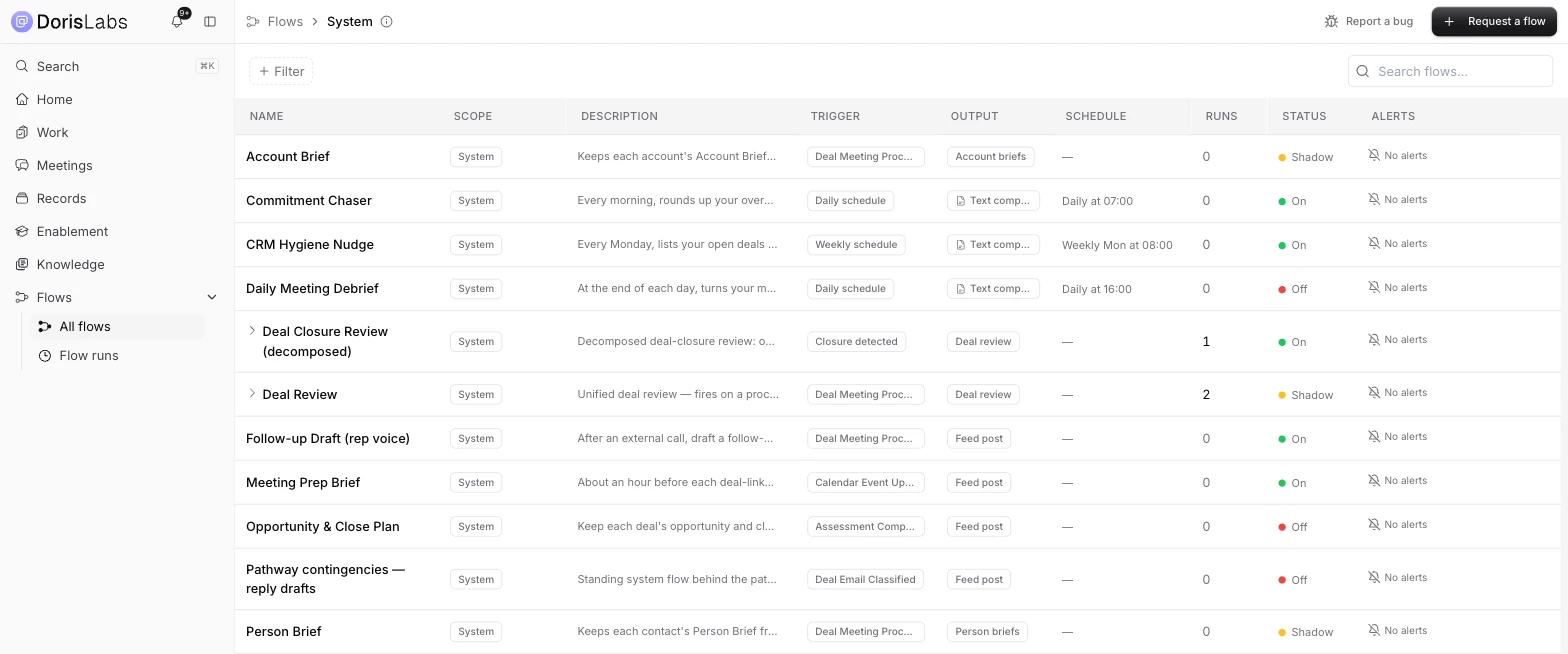
No. Seventeen flows ship with the product, including deal review, commitment chaser, CRM hygiene, meeting prep, meeting debrief, follow-up draft and the weekly report. They arrive switched off. You turn on the ones you want, and you can run one in shadow first to see what it would have done.
Fork the system flow. You get an independent copy to change, and when we republish ours yours is left alone. Or describe the flow you actually want and Doris drafts a new one from scratch.
A personal flow runs for you, and only you can manage it. An administrator has no override on someone else’s personal flow. A workspace flow runs for the company and is managed by admins. The flows we ship are published by us and enabled by you.
See it on your own pipeline.
We'll walk your pipeline with you and show what Doris finds in it.