
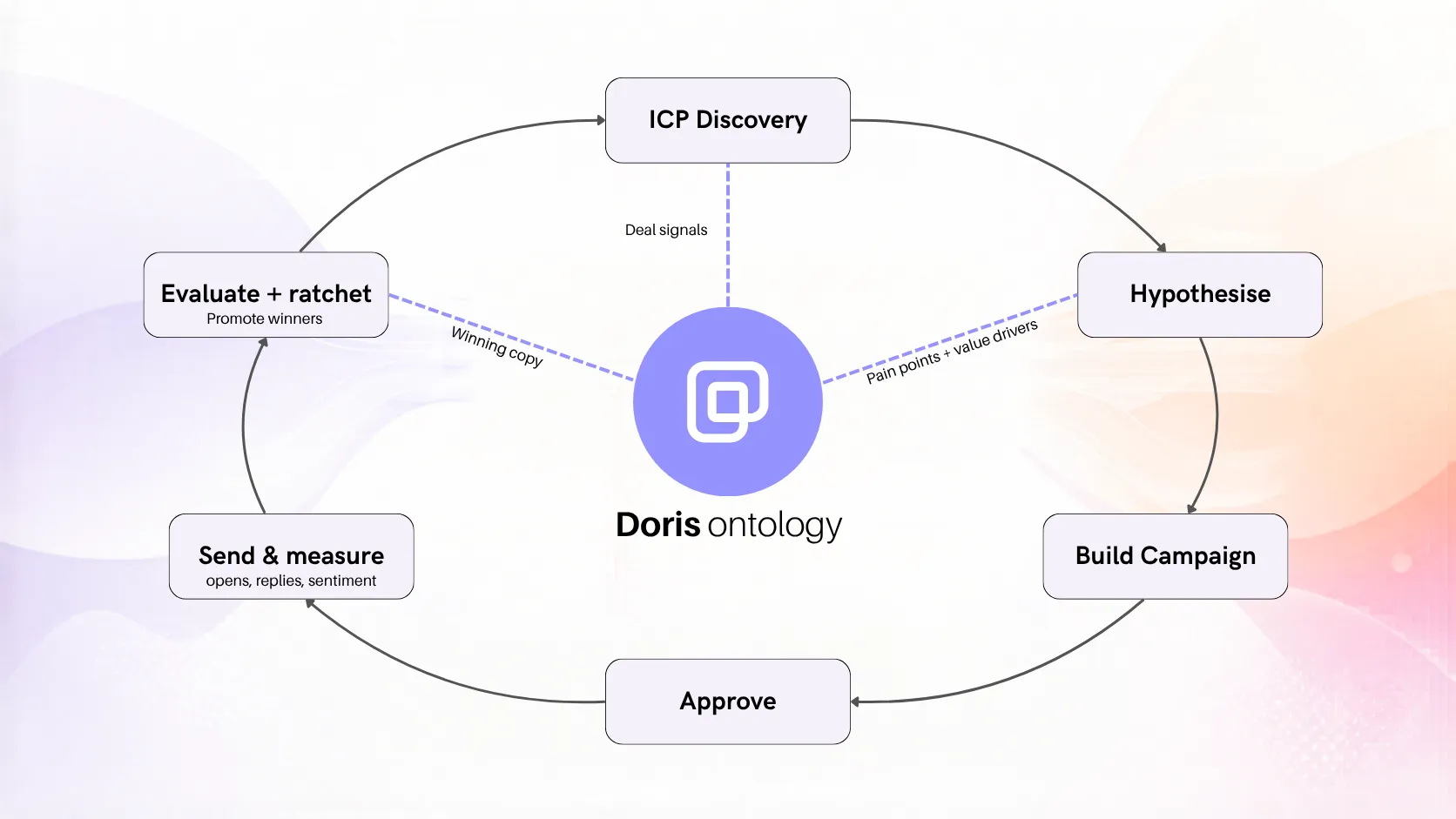
Doris can now run your outbound. Not by giving you another sequence builder, but by connecting outbound directly to the deal intelligence you’ve already built.
Your won deals contain the exact pain points, value drivers, objections, and personas that convert. Until now, that intelligence lived in the ontology but never reached your prospecting. Today it does.
What’s new
ICP profiles auto-discovered from your deals. When deals close, Doris reads the full context: firmographics from your CRM, pain points and value drivers from call transcripts, objections and competitors from meeting analysis. It clusters them into ICP segments. Each profile is an ontology entity, linked to the deals and signals that define it. No persona docs to write.
A daily research loop that experiments with your messaging. Each morning, Doris evaluates yesterday’s campaign results, promotes winning copy, and proposes the next experiment. One variable per test (subject line, hook, value prop, or CTA) against 150 fresh contacts. Winners become the new baseline. Losers are discarded. The system only moves forward.
Human approval before anything sends. The research loop builds everything: finds prospects, writes the sequence, creates the campaign, and queues it for your review. You see the hypothesis, the email copy, a lead sample, and the agent’s reasoning. Approve, adjust, or reject.
Provider-agnostic. Connect your preferred outbound platform. The ontology handles the intelligence. Your provider handles delivery.
Why this is different
Most outbound tools start from a blank page. You define the ICP, write the sequence, set up A/B tests manually, and interpret results yourself. The intelligence comes from you.
Doris starts from what already closed. The ontology knows which pain points appear in won deals, which objections come up at certain company sizes, which value drivers resonate with which personas. Outbound becomes an extension of deal intelligence, not a separate activity.
The research loop compounds this. After 20 experiments, you know that pain-point-first subject lines outperform benefit-first by 60% for a specific ICP. You know which personas respond to conversational tone vs. data-driven tone. None of this was in a playbook. The system discovered it through controlled experimentation against a compounding baseline.
How the loop works
The design follows a pattern where you define an objective metric, set boundaries, and let the system iterate without you in the loop.
Objective metric: positive reply rate.
Boundaries: one variable per experiment, 150-contact tranches, three-step sequences, blocklist and dedup enforcement, GDPR-compliant auto-purge.
The daily cycle:
- Evaluate. Compare the last tranche against the current baseline.
- Ratchet. Promote winners into the ICP’s messaging profile.
- Hypothesise. The agent reads the ICP, the winning baseline, and the full experiment log, then proposes what to test next.
- Build. Search for matching prospects, generate the sequence, create the campaign, queue for approval.
Each experiment is informed by every experiment before it. The hypothesis log is the institutional memory of what works for each buyer segment.
Getting started
Connect a lead provider from Console > Sources, enable the research loop from Growth, and the system starts generating campaigns for your approval.
The ontology is available as an MCP server, queryable from Claude, ChatGPT, or Cursor. The outbound system builds on the same API that powers deal intelligence, meeting prep, and the agent.